E-Commerce Furniture Packaging: How ISTA Drop Tests Reduce Sofa and Mattress Returns

For European furniture importers, E-Commerce furniture packaging is no longer a back-end logistics detail.
It is a profit-protection system.
A sofa may pass the factory inspection.
A mattress may leave the warehouse in perfect shape.But if the packaging fails during parcel handling, warehouse sorting, last-mile delivery or customer unpacking, the buyer still pays the cost.
The loss is not limited to a broken carton.
It can include replacement cost, refund handling, warehouse labor, negative reviews, retail platform penalties and customer-service pressure.
For DACH retailers and online furniture sellers, packaging is now part of product engineering.
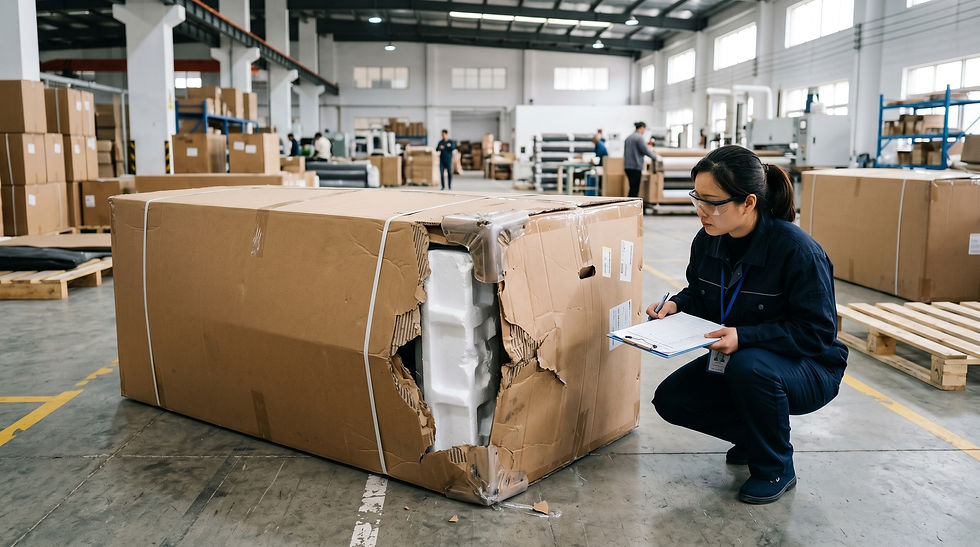
Why E-Commerce Furniture Packaging Matters More in 2026
The keyword E-Commerce furniture packaging reflects a very clear search intent.
Buyers are not looking for decorative packaging.
They are trying to prevent returns.
Furniture is difficult to ship because it is large, heavy and structurally sensitive. Sofas, sofa beds, modular seats and mattresses are exposed to compression, drops, vibration, corner impact, stacking pressure and moisture changes during transit.
For e-commerce furniture, the real question is not:
“Is the carton strong enough?”
The better question is:
“Can the packaging survive the full distribution route before the customer opens it?”
ISTA describes itself as a nonprofit organization focused on minimizing product damage through effective package design, and its test procedures are designed to evaluate packaged products under distribution conditions.
E-Commerce Furniture Packaging and ISTA Drop Tests
ISTA drop testing is not a cosmetic test.
It is used to simulate the shocks and handling risks that a package may experience during shipping. For parcel-delivered products, ISTA Procedure 3A is commonly used for individual packaged products shipped through a parcel delivery system, while other procedures may be selected depending on product weight, route and distribution model.
For furniture, this matters because many damages happen outside the factory.
They happen during:
warehouse sorting
forklift handling
truck vibration
parcel conveyor movement
edge and corner impact
last-mile delivery
customer-side unpacking
A good E-Commerce furniture packaging system should therefore protect the furniture under realistic handling conditions, not only look neat in the factory photo.
UL notes that ISTA packaging tests can include vibration, impact, drop and temperature testing to mimic real-life transportation conditions, including for ready-to-assemble furniture and other furnishings.
E-Commerce Furniture Packaging: Common Failure Points
Most furniture returns caused by shipping damage can be traced back to predictable weak points.
Packaging Failure Point | What Happens in Transit | Buyer Cost |
Weak corner protection | Sofa frame or carton corner is crushed | Replacement, claim handling, customer complaint |
Thin outer carton | Carton tears during warehouse movement | Product contamination or exposed fabric |
Poor foam placement | Impact reaches frame, legs or armrest | Hidden structural damage |
Loose inner parts | Hardware or legs scratch upholstery | Return or partial refund |
No moisture barrier | Fabric or wood absorbs moisture | Mold, odor, surface damage |
Poor carton sizing | Product moves inside the carton | Edge damage and deformation |
Unclear unpacking logic | Customer damages product during opening | Negative review or after-sales dispute |
No test record | Buyer cannot prove packaging reliability | Higher platform and insurance risk |
The key lesson is simple:
Packaging should be engineered around the damage route.
Not around the lowest carton cost.
KD Packaging: Why Knock-Down Design Can Reduce Returns
KD packaging means the product is designed and packed in a more compact, knock-down or modular structure.
For e-commerce furniture, KD packaging can reduce risk in three ways:
Less empty space inside the carton
Less movement means lower impact risk.
Better carton geometry
A compact package is easier to stack, move and load.
Improved container efficiency
Smaller and flatter packages can reduce CBM waste.
But KD packaging only works if the supplier controls both product structure and packaging structure.
A sofa bed, modular sofa or compact apartment sofa cannot simply be disassembled randomly. The supplier must decide which parts can be detached safely, how hardware is protected, how the customer will assemble it and how the carton withstands long-distance transport.
Aoki’s OEM portfolio connects product engineering and logistics engineering. Its workflow includes 3D engineering and loading simulation, with modular parts optimized for up to 95% CBM container utilization; its portfolio also states that e-commerce packaging is simulated for courier handling and drop-tested to reduce last-mile damage.
E-Commerce Furniture Packaging Checklist for DACH Buyers
Before confirming a sofa, sofa bed or mattress order, DACH buyers should review packaging with the same discipline as BOM.
Checkpoint | What to Ask the Supplier | Why It Matters |
Carton specification | What is the carton grade, thickness and edge-crush strength? | Prevents carton collapse |
Corner protection | Are corners protected by foam, honeycomb board or molded inserts? | Reduces impact damage |
Inner fixation | Can the product move inside the carton? | Prevents scratches and frame impact |
Hardware packing | Are legs, screws and accessories isolated? | Prevents upholstery damage |
Moisture protection | Is there a polybag or moisture-control layer? | Protects fabric and wood |
Drop test | Has the packed product been drop-tested? | Validates packaging under shock |
Vibration risk | Is vibration considered for long-distance transport? | Prevents loosening and rubbing |
Loading plan | Is carton orientation planned before shipment? | Reduces warehouse and container damage |
Unpacking guide | Is customer unpacking controlled with clear guidance? | Reduces customer-side damage |
Claim record | Can the supplier track packaging-related claims? | Supports continuous improvement |
This table should be part of the RFQ, not an afterthought after price approval.
Why Low-Cost E-Commerce Furniture Packaging Often Becomes Expensive
A cheaper carton can look attractive in the quotation.
But for online furniture, weak packaging can create costs after the product leaves the factory.
These hidden costs include:
higher damage rate
more replacement shipments
more customer service tickets
platform complaints
lower product reviews
additional warehouse inspection
dispute with carrier or insurance provider
slower inventory turnover
This is why E-Commerce furniture packaging should be calculated as part of landed cost.
A €2 carton saving is meaningless if it causes a €120 sofa replacement.
For DACH buyers, the correct cost question is not:
“How much is the carton?”
It is:
“How much damage risk does this packaging remove?”

How Aoki Designs E-Commerce Furniture Packaging for Sofa and Mattress Buyers
Aoki treats packaging as part of the OEM engineering process.
This is important for sofa and mattress importers because packaging depends on product structure.
For example:
Product Type | Main Packaging Risk | Aoki Engineering Focus |
Modular sofa | Corner impact and carton volume | KD structure, inner fixation, CBM optimization |
Sofa bed | Mechanism protection and hardware damage | Protected moving parts and accessory isolation |
Compact apartment sofa | Customer unpacking and assembly risk | Clear packaging sequence and component logic |
Roll-pack mattress | Compression recovery and edge deformation | Roll-pack control, carton protection and rebound verification |
Hotel sofa | Batch consistency and project delivery damage | Carton labeling, protected upholstery and controlled loading |
Aoki’s positioning is not based on decorative packaging.
It is based on reducing hidden after-sales cost.
The company’s earlier content strategy also showed that DACH buyers respond better to engineering evidence than promotional claims, especially when content addresses structural risk, e-commerce returns and EU compliance issues.
E-Commerce Furniture Packaging RFQ Template
When requesting a quotation from a furniture OEM supplier, importers should include packaging requirements directly in the RFQ.
RFQ Field | Example Requirement |
Sales channel | E-commerce, retail store, marketplace, hotel project |
Product type | Modular sofa, sofa bed, compact sofa, roll-pack mattress |
Delivery route | Factory to warehouse, warehouse to customer, direct parcel |
Target market | Germany, Austria, Switzerland or wider EU |
Packaging test | ISTA drop test, internal drop test or buyer-specific test |
Carton labeling | SKU, batch, room, component or delivery sequence |
Customer assembly | Required or not required |
Replacement parts | Hardware kit, legs, covers or cushions |
Damage tolerance | Target claim rate or buyer internal benchmark |
Documentation | Packaging photo, drop-test record, loading plan |
This allows the supplier to quote a realistic packaging solution instead of a low-cost carton that later fails in distribution.
Final Recommendation: Treat E-Commerce Furniture Packaging as Product Engineering
Good E-Commerce furniture packaging is not about adding more foam.
It is about engineering the full journey from factory to customer.
For DACH importers and online retailers, the packaging decision should be made before mass production starts.
The best supplier will be able to show:
product structure logic
KD packaging plan
carton and inner-protection details
drop-test evidence
loading simulation
clear ETD and shipment plan
continuous improvement based on claims
Aoki is suitable for buyers who need sofa and mattress OEM production with packaging logic built into the project from the beginning.
For e-commerce furniture, the sale is not complete when the container leaves China.
The sale is complete when the customer opens the carton and the product is still in sellable, usable condition.
That is the real purpose of packaging.
CTA
Request the free E-Commerce Furniture Packaging Checklist
Use it to evaluate carton structure, KD design, drop-test evidence, CBM utilization and last-mile damage risk before confirming your next sofa or mattress order.
Contact: baosen@aokifurnitures.com
Website: Aokifurnitures.com


Comments